
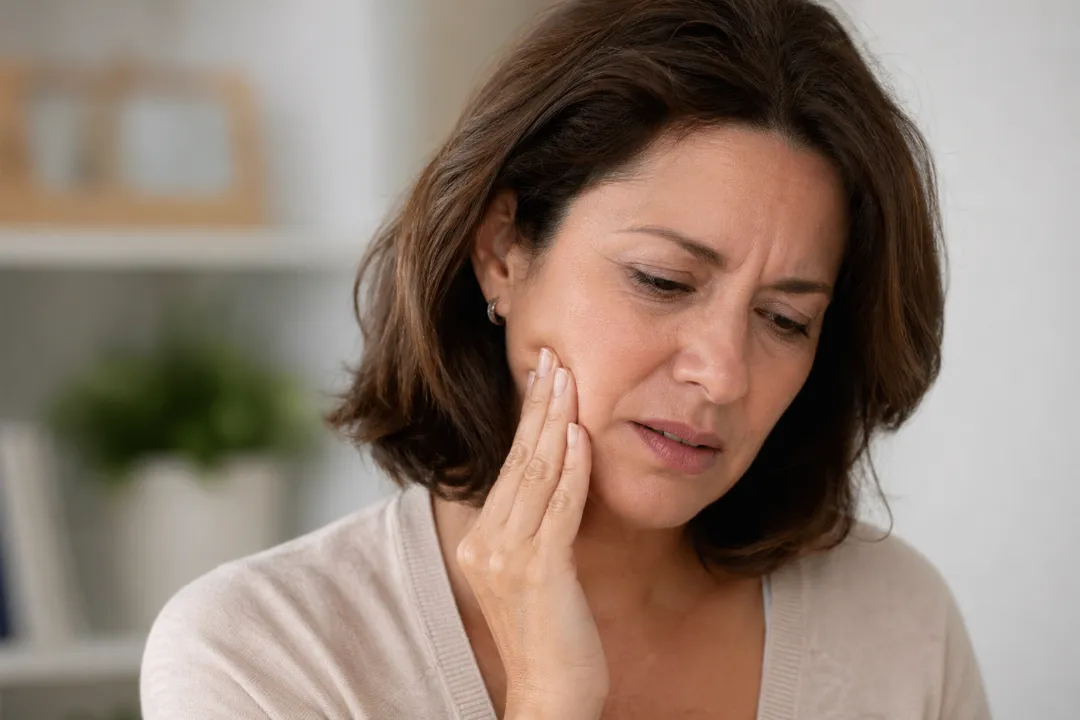
TMJ (temporomandibular joint) pain is jaw pain caused by stress, teeth grinding, poor hydration, missing teeth, or misaligned bite. In Dubai, it is extremely common due to high-stress lifestyles and the hot climate affecting hydration. The good news: most TMJ cases are fully manageable without surgery. Dr. Suraj Pawar at Dental Oasis JLT, Dubai treats the majority of TMJ patients with prescribed physiotherapy exercises and an occlusal splint (night guard). Results depend entirely on how well the patient follows the treatment. Botox, ultrasound, and surgery are considered only as last resorts when conservative treatment has failed.
1. What Is the TMJ and What Is TMJ Disorder?
Your temporomandibular joint (TMJ) is the hinge that connects your lower jaw (mandible) to your skull, just in front of each ear. You use it every single time you speak, eat, yawn, or swallow. It is one of the most complex and frequently used joints in the entire human body.
TMJ disorder (TMD) is the umbrella term for pain and dysfunction affecting this joint and the muscles that control jaw movement. It can feel like a simple ache near your ear, or it can radiate as headaches, neck pain, and even shoulder tension. It often gets mistaken for earache, migraine, or sinus pain — which is why many patients in Dubai spend months treating the wrong problem.
🦷 Where Is Your TMJ?
Place your fingertips just in front of your ears and open your mouth. The movement you feel under your fingers is your temporomandibular joint at work. If you feel pain, tenderness, or a clicking sensation there — that is your TMJ telling you something is wrong.
2. Common Symptoms — How Do You Know It’s TMJ?
TMJ disorder presents in many ways. The symptoms below — especially in combination — strongly suggest a TMJ problem:
| Common TMJ / Jaw Problem Symptoms | |
| 😬 Jaw pain or tenderness near the ear | 🔊 Clicking or popping when opening mouth |
| 🤕 Morning headaches on waking | 👂 Ear pain without any ear infection |
| 😶 Difficulty fully opening or closing mouth | 😤 Jaw feels stiff or locked |
| 🦷 Teeth grinding (bruxism) at night | 🫁 Neck and shoulder muscle tension |
| 😵 Facial pain or fatigue after eating | |
Often Mistaken For Something Else
Many TMJ patients in Dubai have previously been treated for ear infections, migraines, sinus problems, or cervical spine issues — without relief. If symptoms persist despite treating those conditions, a TMJ evaluation with Dr. Suraj Pawar is strongly recommended. A thorough clinical examination quickly identifies whether the jaw joint is the true source of pain.
3. What Causes TMJ Pain in Dubai?
TMJ disorder is rarely caused by one single thing. It is almost always a combination of factors — and in Dubai specifically, certain triggers are particularly common.
| Common Causes of TMJ / Jaw Problems | |
| 😰 Stress & Jaw Clenching Dubai’s demanding work culture means many residents carry significant stress. The subconscious response is to clench the jaw — during the day and especially at night while sleeping. This places enormous repeated pressure on the TMJ and surrounding muscles. | 💧 Dehydration In Dubai’s extreme heat, dehydration is common and often underestimated. Fluid is essential to keep joint cartilage lubricated and jaw muscles supple. Dehydrated muscles cramp more easily and the cartilage disc inside the TMJ loses its shock-absorbing capacity. |
| 🦷 Missing Teeth A gap left by a missing tooth shifts the balance of how your upper and lower jaws meet. The jaw compensates by repositioning slightly — putting uneven, chronic stress on the TMJ over months and years. | 😬 Misaligned Teeth (Malocclusion) When the teeth do not bite together evenly — whether from crowding, a deep bite, an open bite, or a crossbite — the jaw joint has to work harder and in an unnatural position to achieve a functional bite. |
| 🌙 Teeth Grinding (Bruxism) Most people who grind their teeth do it at night without realising. The repetitive grinding motion wears down tooth surfaces and places intense load on the jaw joint and muscles — a leading cause of TMJ pain. | 📱 Posture & Lifestyle Habits Hours hunched over a phone or laptop, chewing hard or crunchy foods frequently, chewing on one side only, or habits like nail-biting and pen-chewing all contribute to TMJ strain over time. |
4. Lifestyle Factors That Make TMJ Worse — and What to Change
Before any treatment begins, Dr. Suraj Pawar reviews the patient’s daily habits. Many people are unknowingly making their TMJ significantly worse through everyday lifestyle choices. The good news: most of these are easy to change.
💧 Stay Hydrated — Especially in Dubai
This is one of the most consistently overlooked factors in jaw pain. The cartilage disc inside your TMJ needs adequate fluid to function as a shock absorber. The muscles around the jaw — like all muscles — are more prone to cramping and spasm when dehydrated. In Dubai’s climate, where temperatures exceed 45°C in summer and air conditioning creates very dry indoor environments, most people are not drinking nearly enough water.
Aim for at least 2.5–3 litres of water per day. This alone has helped many patients notice a meaningful reduction in jaw muscle tension within weeks.
😴 Sleep Quality and Jaw Position
Poor sleep and stress go hand in hand with TMJ. If you wake with a sore jaw, headache, or tired facial muscles — you are almost certainly grinding or clenching at night. An occlusal splint (see Section 9) addresses this directly.
🍽️ Diet and Chewing Habits
- Avoid excessively hard foods (hard nuts, raw carrots, tough meats, ice chewing) during a flare-up
- Chew on both sides equally — chewing only on one side creates imbalanced load on the joint
- Avoid chewing gum — it keeps the jaw joint under constant repetitive strain
- Cut food into smaller pieces rather than taking large bites that require wide jaw opening
📱 Posture — The Hidden TMJ Trigger
Forward head posture — the neck angled forward from staring at a phone or laptop — alters the natural position of the jaw and increases strain on the TMJ. Simple posture correction exercises prescribed as part of physiotherapy can make a significant difference.
✅ Simple Daily Habits That Help TMJ Recovery
- Drink 2.5–3 litres of water daily
- Keep lips together, teeth slightly apart when resting — teeth should not be touching
- Avoid clenching your jaw during stressful moments — consciously release it
- Apply warm compress to the jaw for 10–15 minutes if pain or stiffness is present
- Avoid wide yawning — support your chin gently when you feel a yawn coming
- Improve your screen posture — chin tucked, ears above shoulders
5. How Missing Teeth Cause TMJ Pain
This connection surprises many patients — but it is one of the most well-established causes of TMJ disorder, and one that Dr. Suraj Pawar sees frequently in Dubai.
Every tooth in your mouth plays a role in how your upper and lower jaws come together when you bite. Think of it like a table with legs — remove one leg and the entire structure tilts and compensates. When a tooth is missing:
- The neighbouring teeth drift and tilt into the gap over time
- The opposing tooth above or below over-erupts (moves downward or upward into the space)
- The bite becomes uneven — certain teeth bear more pressure than they should
- The jaw shifts position to find a comfortable bite, placing the TMJ in a strained, off-centre position
- Over months and years, this chronic imbalance causes joint pain, muscle fatigue, and clicking
🦷 Replacing Missing Teeth Is Part of TMJ Treatment
If missing teeth are contributing to your TMJ, replacing them with dental implants or a dental bridge restores the balanced bite and removes the source of uneven joint loading. Dr. Suraj Pawar addresses both the TMJ symptoms and the missing teeth as a combined treatment plan — not as separate problems.
6. How Misaligned Teeth Affect Your Jaw Joint
Your jaw joint is designed to work in a specific, balanced alignment. When teeth are crowded, rotated, have a deep overbite, open bite, or crossbite — the jaw cannot close in its natural, relaxed position. Instead, the muscles have to guide the jaw into a compensated position on every bite. Do this thousands of times a day for years, and the result is a chronically strained, inflamed jaw joint.
Correcting teeth alignment through orthodontic treatment — braces or clear aligners — removes the root cause of the bite-related TMJ stress. This is why Dr. Suraj Pawar evaluates the bite thoroughly in every TMJ patient, and recommends alignment correction where it is a contributing factor.
💡 Not Every Misalignment Needs Full Orthodontics
In some cases, simple bite equilibration — smoothing or reshaping specific tooth contacts that are causing uneven pressure — provides significant TMJ relief without full orthodontic treatment. Dr. Suraj Pawar assesses what level of correction is needed for each individual patient.
7. How Dr. Suraj Pawar Treats TMJ at Dental Oasis JLT
“The majority of my TMJ patients do not need surgery, Botox, or ultrasound. What they need is the right physiotherapy programme, an occlusal splint fitted correctly, and the commitment to follow through. The treatment works — but the results are entirely in the patient’s hands. I provide the tools; the patient has to use them consistently.”
— Dr. Suraj Pawar, Oral & Maxillofacial Surgeon & Implantologist, Dental Oasis JLT, Dubai
Dr. Suraj Pawar’s approach to TMJ follows a clear, staged pathway — starting with the most conservative, lowest-risk treatments first and escalating only when necessary:
1
First Line — Always Start Here
Physiotherapy + Occlusal Splint
Prescribed jaw exercises targeting the specific muscles causing dysfunction, combined with a custom-fitted night splint. This combination resolves the majority of TMJ cases. Results depend on patient compliance — wearing the splint every night and performing the exercises as instructed.
2
Address Contributing Causes
Bite Correction — Missing Teeth & Alignment
If missing teeth or a misaligned bite is identified as a contributing factor, tooth replacement (dental implants or bridge) or orthodontic treatment is recommended alongside physiotherapy.
3
Last Resort Only
Botox · Ultrasound · Surgery
Only considered when the patient has genuinely followed all conservative treatment consistently and has not achieved adequate relief. These interventions are reserved for a small minority of complex, refractory cases.
8. Physiotherapy — The Most Important Treatment for TMJ
This is the cornerstone of TMJ treatment at Dental Oasis JLT — and it is often the only thing needed. Dr. Suraj Pawar prescribes a specific set of jaw physiotherapy exercises tailored to each patient’s presentation.
What Does TMJ Physiotherapy Involve?
- Jaw muscle stretching exercises to reduce tightness in the masseter and pterygoid muscles
- Controlled opening and closing movements to retrain the jaw to open symmetrically without deviation
- Postural correction exercises for the neck and upper back — poor posture is a major TMJ aggravator
- Relaxation techniques to reduce subconscious clenching during the day
- Warm compress application to relax jaw muscles before exercises
⚠️ Results Depend Entirely on Patient Commitment
Physiotherapy for TMJ is not a passive treatment — it requires the patient to perform the exercises as prescribed, every day, consistently over weeks and months. Patients who do this see significant and often complete resolution of their symptoms. Patients who do the exercises sporadically or stop early often see little improvement and may incorrectly conclude that the treatment did not work.
The exercises work. The splint works. But only when used as directed.
9. Occlusal Splint — What It Is and Why It Works
An occlusal splint (also called a night guard, bite guard, or Michigan splint) is a custom-made hard acrylic appliance that fits precisely over your upper or lower teeth. It is worn primarily at night.
How Does It Help TMJ?
- It prevents the upper and lower teeth from contacting each other during grinding — removing the damaging force from the joint
- It holds the jaw in a therapeutically relaxed, decompressed position that takes pressure off the TMJ
- It relaxes the overworked jaw muscles — patients often wake with significantly less facial tension and headaches
- It protects tooth surfaces from wear caused by grinding
- It allows the inflamed joint and surrounding tissues to heal undisturbed during sleep
✅ Key Points About Your Occlusal Splint
- It must be custom-made from impressions of your teeth — over-the-counter guards from pharmacies do not provide therapeutic benefit and can sometimes make things worse
- Wear it every night without exception — skipping nights reduces its effectiveness
- Clean it every morning with a soft toothbrush and cool water
- Bring it to every follow-up appointment — Dr. Suraj Pawar checks the fit and adjusts as needed
- Most patients notice an improvement in morning jaw stiffness and headaches within 2–4 weeks of consistent use
10. Botox, Ultrasound & Surgery — Last Resort Only
These interventions exist and have a role in medicine — but at Dental Oasis JLT, they are never the starting point. They are considered only when:
- The patient has genuinely and consistently followed physiotherapy and splint therapy
- Adequate time has been given for conservative treatment to work
- Contributing factors (missing teeth, bite issues) have been addressed
- Relief remains insufficient despite full compliance
| Treatment | What It Does | When Considered |
|---|---|---|
| Botox Injection | Injected into the masseter muscle to reduce its clenching force. Temporary — typically lasts 3–6 months. Needs repeat treatment. | Last resort — after physiotherapy and splint have failed |
| Ultrasound Therapy | Deep heat applied to jaw muscles and joint to reduce inflammation and improve mobility. | Last resort — adjunct when physiotherapy alone is insufficient |
| Arthrocentesis (joint washout) | Minor surgical irrigation of the joint to remove inflammatory debris and improve disc mobility. | Surgery — only for severe structural joint problems unresponsive to all other treatment |
| Open Joint Surgery | Surgical repair or replacement of joint structures. | Extreme last resort — rare, reserved for severe structural joint damage |
🚫 Beware of Clinics That Recommend Surgery or Botox as a First Step
If a clinic recommends Botox injections or any surgical TMJ procedure without first properly trialling physiotherapy and an occlusal splint — seek a second opinion. The overwhelming majority of TMJ patients respond to conservative management. Surgery carries real risks and should never be rushed into.
11. Frequently Asked Questions
What causes TMJ pain in Dubai specifically?
Dubai’s high-stress work environment, long screen hours, extreme heat causing dehydration, and a busy lifestyle with poor sleep habits all contribute to TMJ being particularly prevalent among residents and expats. These factors drive jaw clenching, grinding, and muscle tension — the three most common triggers of TMJ pain.
Can TMJ be cured completely?
In most cases, yes — or at the very least, brought under complete control. Patients who commit to the prescribed physiotherapy exercises and wear their occlusal splint consistently achieve excellent results. The key word is commitment — TMJ treatment is not passive. The better you follow the programme, the better your outcome.
Is the clicking sound in my jaw dangerous?
A clicking or popping sound when opening or closing the mouth is very common with TMJ and usually indicates the disc inside the joint is slightly displaced or the joint surfaces are not gliding smoothly. In most cases it is not dangerous and improves with treatment. If clicking is accompanied by pain, locking, or limited opening, it should be evaluated promptly.
How long does TMJ treatment take?
Most patients notice meaningful improvement within 4–8 weeks of consistent physiotherapy and splint use. Full resolution of symptoms can take 3–6 months. In complex cases or where contributing dental factors need addressing, the timeline is longer. The key is not to stop treatment when you start feeling better — continue until Dr. Suraj Pawar confirms it is safe to do so.
Does an occlusal splint cure TMJ or just manage it?
The splint is a therapeutic tool, not a permanent cure by itself. Used alongside physiotherapy and lifestyle changes, it allows the joint and muscles to heal. Many patients find their symptoms resolve completely and no longer need the splint long-term. Others — particularly those prone to stress-related grinding — use it as a maintenance tool to prevent recurrence.
Can I get dental implants if I have TMJ?
Yes — in fact, if missing teeth are contributing to your TMJ, getting an implant is part of the solution. However, Dr. Suraj Pawar will ensure the TMJ is adequately managed before placing implants, as uncontrolled grinding or jaw dysfunction can affect implant outcomes. Both conditions are managed together as a coordinated treatment plan.
Is TMJ treatment covered by insurance in Dubai?
Coverage varies by insurer and policy. Occlusal splints and diagnostic consultations are covered by some Dubai health plans. It is recommended to check with your provider before your appointment, or ask at Dental Oasis JLT — the team can advise on documentation needed for insurance claims.