
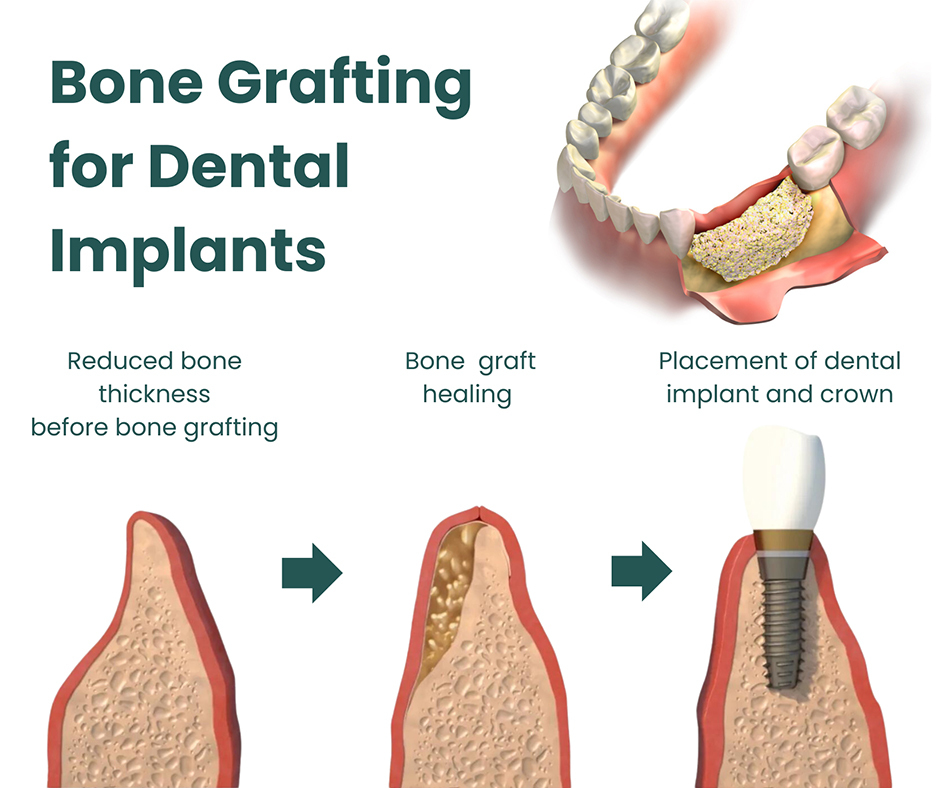
Bone grafting is a preparatory surgical procedure that rebuilds lost jawbone volume using graft material, giving a future dental implant the solid, thick foundation it needs to fuse successfully. Without adequate bone width and height, an implant has nothing stable to anchor into and is at high risk of failure. A bone graft is not a separate journey — it is simply the first, essential chapter in your implant success story.
When patients come to my practice at Dental Oasis DMCC asking why they can’t just “get the implant done today,” I often have to explain a biological reality that surprises most people: teeth and bone have a relationship of mutual dependence. The tooth root doesn’t just sit in bone — it actively signals to the bone to stay strong. The moment that root is gone, that signal disappears, and the jawbone begins a slow, silent process of shrinking away.
Why Your Jawbone Disappears After Tooth Loss
In my maxillofacial surgery practice, I compare healthy bone around a tooth root to soil packed tightly around the roots of a mature tree. The roots hold the soil in place, and the soil, in turn, keeps the tree upright and nourished. Remove the tree, and over time, wind and rain wash that soil away until there’s nothing firm left to plant a new sapling in.
Your jawbone behaves the same way. Once a tooth is extracted or lost, the bone that used to surround it starts to resorb — it loses width first, then height, often losing up to 25% of its volume within the first year alone. This is precisely why patients who lost a tooth five years ago frequently need more extensive reconstruction than someone who lost a tooth five months ago.
The Clinical Checklist: Signs You May Need a Bone Graft
During your in-person diagnostic review at Fortune Tower, I evaluate several specific factors to determine whether your jaw can accept an implant directly, or whether grafting must come first:
- Time Since Extraction: Missing a tooth for more than 12 months significantly increases the likelihood of measurable bone loss.
- History of Periodontal (Gum) Disease: Chronic gum infection is one of the most aggressive destroyers of the bone that anchors your teeth.
- Prior Ill-Fitting Dentures: Long-term denture wear places uneven pressure on the ridge, accelerating bone resorption underneath.
- Traumatic Tooth Loss: Fractures or trauma-related extractions often damage the surrounding bone wall (the socket), not just the tooth itself.
- Thin Ridge Profile on Palpation: During your clinical exam, I can often feel a “knife-edge” ridge that signals insufficient width for implant stability.
- Insufficient Vertical Height on Imaging: Our baseline radiograph reveals whether you have enough bone height to safely avoid nearby structures like nerves or the sinus floor.
Matching the Graft to Your Anatomy
Not every patient needs the same type or scale of grafting. When analyzing a patient’s bone density profile, I select the most conservative approach that will still guarantee long-term implant stability — over-treating is never our goal.
| Grafting Approach | Clinical Indication | Material Source | Typical Healing Window |
|---|---|---|---|
| Socket Preservation Graft | Placed immediately after an extraction to prevent collapse of the socket walls. | Synthetic or donor-derived granules | 3 to 4 months |
| Minor Ridge Augmentation | Mild width deficiency in a localized area, often a single tooth site. | Patient’s own bone (autograft) or donor graft | 4 to 5 months |
| Block Bone Grafting | Significant width or height loss across a wider span of the jaw. | Solid block, typically autograft | 5 to 6 months |
| Guided Bone Regeneration (GBR) | Combined with a protective membrane to shape new bone growth precisely. | Granules plus a resorbable or non-resorbable membrane | 4 to 6 months |
What Actually Happens During the Graft Procedure
The process itself is far gentler than most patients imagine, and it follows a controlled, predictable sequence:
- Site Preparation Under Local Anesthesia: The area is fully numbed, and profound comfort is confirmed before any instrumentation begins.
- Placement of Graft Material: Biocompatible granules or a block graft are carefully packed into the deficient area, acting as a scaffold.
- Membrane Coverage (When Needed): A thin protective membrane may be placed over the graft to keep it contained and to guide new bone cells into the correct shape.
- Closure and Healing: The gum tissue is closed, and over the following months your own biology takes over — new bone cells gradually replace the graft material with living, load-bearing bone.
Our surgical safety protocol treats this healing phase as sacred. Rushing an implant into a graft that hasn’t matured is one of the most common causes of late implant failure, and it’s a shortcut I simply don’t take in my practice.
Serving JLT, Dubai Marina, and Surrounding Communities
Located at Office 405, 4th Floor, Fortune Tower, Cluster C, JLT, just a short two-minute walk from the DMCC Metro Station, Dental Oasis DMCC is a natural stop for patients across Dubai Marina and the wider JLT community seeking specialist-level bone and implant care. We understand that treatment planning also involves practical logistics, which is why we assist with clear, transparent documentation to support diagnostic and baseline imaging coordination through major UAE insurance networks including NextCare and Inaya.
Your Bone Deserves a Personalized Map, Not a Guess
Every jaw carries a different history — different amounts of bone loss, different densities, different healing capacities. This is precisely why bone grafting can never be responsibly diagnosed over a phone call or a text message photo. What looks like a small gap on the surface can hide a significantly resorbed ridge underneath.
I invite you to schedule a dedicated structural consultation at Dental Oasis DMCC, Office 405, Fortune Tower, Cluster C, JLT, Dubai. Together, we’ll take a baseline diagnostic radiograph, assess your bone profile in person, and map out a clear, predictable, and comfortable path toward a stable, lasting implant foundation.