
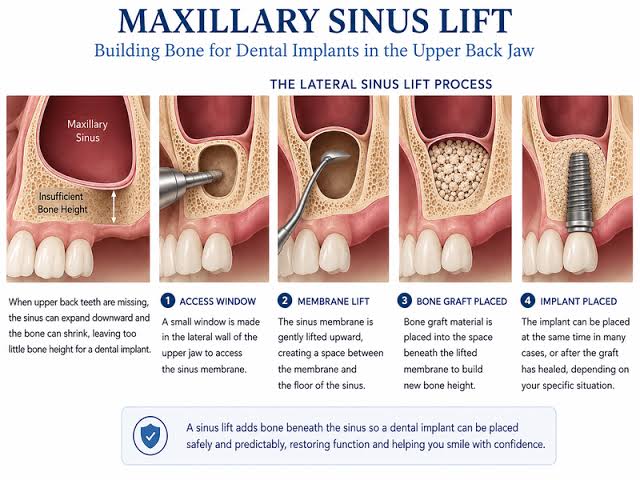
Placing dental implants in the upper back jaw requires an in-depth evaluation of your maxillary sinus, as missing teeth cause the sinus floor to drop and the surrounding bone to rapidly melt away. If there is insufficient bone height, a specialized sinus lift must be performed to safely elevate the sinus membrane, or alternatively, advanced short implants can be utilized to avoid bone grafting altogether. Attempting to place a standard implant here without precise anatomical mapping can result in sinus perforation, chronic infections, and immediate surgical failure.
When patients visit my practice at Dental Oasis JLT seeking to replace missing upper molars or premolars, they are often surprised to learn that the treatment involves more than just the teeth. In my maxillofacial surgery practice, the upper back jaw is treated as a highly sensitive anatomical zone. This area directly borders the maxillary sinuses—the hollow, air-filled spaces located just behind your cheekbones and right above your upper tooth roots.
When your natural upper teeth are healthy, their roots act like anchors, stimulating the surrounding bone and keeping it strong. However, once an upper tooth is lost, a double-edged biological process begins. Not only does the jawbone resorb (shrink) from the oral cavity side, but the sinus cavity above also expands downward into the empty space. This expansion is known as sinus pneumatization, and it can leave behind a shelf of bone that is paper-thin.
1. Recognizing the “Low Sinus” Profile: A Clinical Checklist
To determine whether your anatomy allows for a straightforward implant, requires a sinus lift, or qualifies for a graft-less short implant, we map your structures during an in-person diagnostic review. A simple phone inquiry or text message can never evaluate the thin structures separating your oral cavity from your respiratory system.
During your clinical evaluation at Fortune Tower, Cluster C, I scan for specific indicators to determine the health and position of your maxillary sinus:
- Duration of Tooth Loss: If you have been missing upper back teeth for more than 6 months, significant bone resorption and sinus drop have almost certainly begun.
- Prior Severe Periodontal Disease: Chronic gum infections systematically destroy the alveolar bone housing the tooth roots, accelerating the loss of vertical bone height.
- Anatomical Sinus Variance: Every individual’s sinus geometry is unique; some patients naturally possess deep, expansive sinus cavities that leave minimal room for standard implant fixtures.
- Chronic Sinusitis History: We thoroughly review your medical history. If you experience frequent seasonal sinus blockages or chronic inflammation, these conditions must be stabilized before any joint bone-and-sinus intervention.
2. The Traditional Solution: The Sinus Lift Process
When our high-house panoramic radiograph (OPG) indicates an insufficient bone height—specifically less than 6 millimeters of residual bone—a standard implant cannot be securely anchored without modification. To fix this, we can perform a routine but highly technical procedure known as a sinus lift (sinus augmentation).
The objective is simple yet precise: gently lift the floor of the sinus upward to pack high-quality bone graft material underneath, creating the necessary vertical depth for a stable, full-length implant.
The advanced lateral sinus lift protocol follows a strict, highly controlled sequence to guarantee comfort and safety:
- Creating the Access Window: Under profound local anesthesia, a microscopic access window is made in the lateral wall of the upper jaw bone.
- The Gentle Membrane Lift: Utilizing specialized, ultra-smooth surgical instruments, the delicate, paper-thin sinus membrane is carefully detached and lifted upward. This creates a secure, protected space between the membrane and the floor of the sinus.
- Packing the Bone Graft Material: The newly created space beneath the lifted membrane is safely packed with biocompatible bone graft material, which acts as a scaffold for your body to grow its own new bone.
- Implant Placement: Depending on your existing baseline bone stability, the dental implant can either be placed at the exact same time as the graft, or after a dedicated healing window of a few months to allow the new bone height to fully mature.
3. The Graft-Less Alternative: Advanced Short Implants
For patients who are highly anxious about undergoing a bone graft or a sinus lift, modern biomimetic engineering offers a brilliant alternative that I utilize frequently in my practice: Short Implants.
Instead of gaining vertical bone height by pushing into the sinus, we use premium engineered implants that are significantly shorter but slightly wider. These short implants are designed with specialized surface macro-topographies that distribute heavy chewing forces laterally across the available bone, completely avoiding the maxillary sinus cavity.
The Strict Prerequisites for Short Implants
While short implants allow you to completely bypass the time and cost of bone grafting, they still require a definitive, baseline threshold of healthy bone. During your consultation, I will use our diagnostic imaging to ensure you meet the exact anatomical requirements:
- Minimum Bone Height: You must have a minimal vertical bone height of 6 mm beneath the sinus floor.
- Minimum Bone Width: Your residual ridge must have a minimal horizontal thickness of 4 mm to fully and safely encase the wider diameter of a short implant.
If your bone profile meets these parameters (6 mm height and 4 mm width), we can completely eliminate the sinus lift step, drastically reducing your overall treatment time, surgical discomfort, and healing window.
4. Comparing Your Options: Internal Lift vs. Lateral Lift vs. Short Implants
Depending on your exact bone measurements, we select the most conservative method possible to ensure your recovery is smooth, predictable, and tailored to your lifestyle.
| Clinical & Surgical Parameters | Internal Sinus Lift (Osteotome Technique) | Lateral Sinus Lift (Open Window Technique) | Short Implants (The Graft-Less Alternative) |
|---|---|---|---|
| Anatomical Indication | Minor bone deficiency (5 mm to 8 mm of existing vertical bone height). | Severe bone deficiency (less than 5 mm of existing vertical bone height). | Moderate deficiency (minimum 6 mm height and minimum 4 mm width required). |
| Bone Grafting Required? | Yes, minor localized bone graft placement. | Yes, comprehensive bone graft volume packed under the membrane. | No bone grafting or sinus lifting required. |
| Surgical Approach | Accessed directly through the vertical channel prepared for the implant. | Accessed via a small window created on the side wall of the jaw bone. | Placed routinely into the existing bone ridge, completely avoiding the sinus. |
| Overall Treatment Timeline | Implant is placed simultaneously; total crown delivery in 3 to 4 months. | Can require a staged approach; total timeline can take 4 to 9 months. | Fast-tracked timeline; crown delivery ready in 3 months. |
| Recovery Window | Minimal; mild pressure sensation for 24 to 48 hours. | Routine post-op swelling for 3 to 5 days; managed with anti-inflammatories. | Extremely minimal; virtually identical to a standard simple extraction. |
5. Premium Maxillofacial Protocols at Dental Oasis JLT
Choosing a Specialist Oral and Maxillofacial Surgeon for upper jaw reconstruction ensures your treatment is guided by deep surgical expertise, an understanding of midfacial anatomy, and mastery over both grafting and graft-less short implant technologies. Our surgical protocols are designed to deliver exceptional precision while keeping you relaxed, comfortable, and completely informed.
Located just a short, two-minute walk from the DMCC Metro Station, our practice serves professionals and families across JLT, Dubai Marina, and surrounding communities. We emphasize absolute transparency throughout your care. From your initial examination, we provide clear documentation to assist with smooth insurance coordination and baseline diagnostic approvals through major premium UAE networks like NextCare and Inaya.
Secure Your Individual Structural Map
Every jaw structure, bone density profile, and sinus line follows a completely unique biological pattern that cannot be accurately diagnosed or priced over a telephone call. To find out if you qualify for the graft-less 6mm short implant or if a conservative sinus lift is the safer choice for your long-term health, an in-person evaluation is essential.
We invite you to schedule a dedicated structural consultation at Dental Oasis DMCC, located at Office 405, 4th Floor, Fortune Tower, Cluster C, JLT, Dubai. Let us review your anatomy, take a baseline diagnostic radiograph, and create a predictable, comfortable path to restoring your smile.