
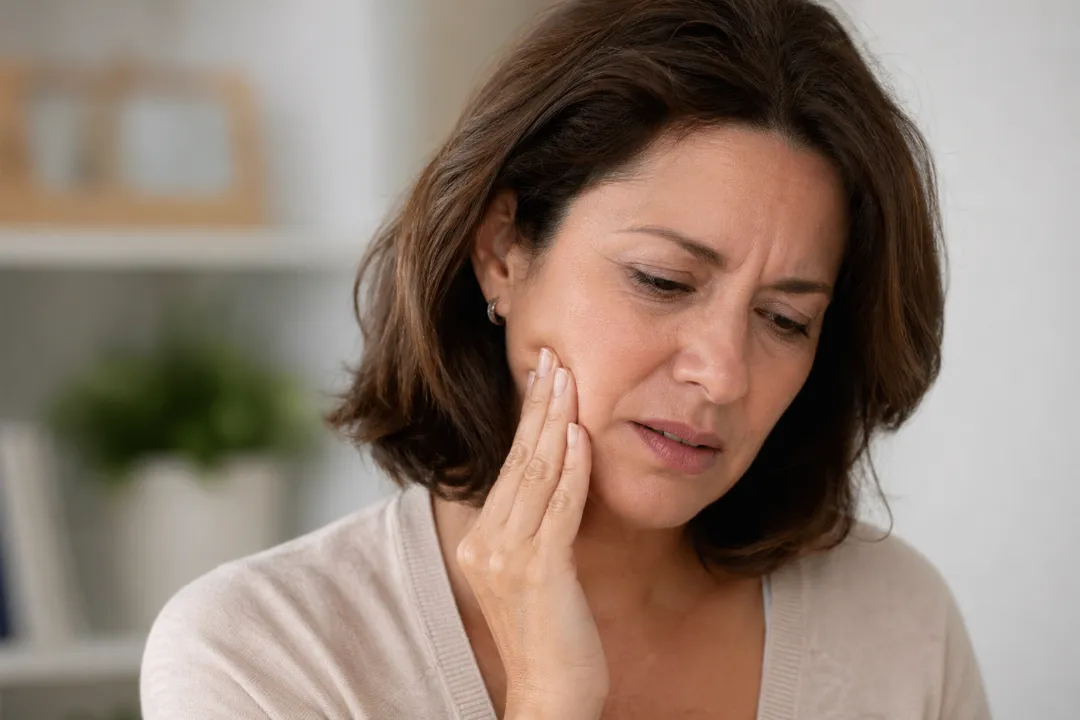
Why Does My Jaw Hurt on One Side?
Dissecting TMJ, Infection, and Wisdom Teeth
One-sided jaw pain near the ear in Dubai is most commonly caused by one of five conditions: TMJ disorder, an impacted lower wisdom tooth, a dental abscess, bruxism-related muscle spasm, or a cracked molar. Each produces a different pattern of pain — dull morning aching suggests bruxism or TMJ; throbbing deep pressure points to infection or an impacted wisdom tooth; sharp pain on wide opening indicates TMJ disc displacement. A definitive diagnosis requires clinical examination and — in most cases — a 3D CBCT scan by an Oral & Maxillofacial Specialist, not a GP or general dentist. At Dental Oasis JLT, Cluster C, Fortune Tower, Dubai, Dr. Suraj Pawar offers same-day diagnostic assessments and WhatsApp triage at +971 58 521 7979.
1. Master Diagnostic Table — Symptoms Mapped to Root Causes
In my clinical practice at Dental Oasis JLT, the first thing I do when a patient presents with one-sided jaw pain is listen carefully to the character of the pain — not just its location. The quality, timing, and triggers of jaw pain are far more diagnostically specific than the patient often realises. This table is the same mental framework I use at every consultation:
| Symptom Pattern | Most Likely Cause | Urgency | Key Distinguishing Feature |
|---|---|---|---|
| Dull, achy jaw on waking — worse in the morning | Bruxism | Routine | Muscles fatigued from overnight grinding; improves as day progresses; partner may report grinding sounds |
| Sharp pain when opening mouth wide, clicking or popping near the ear | TMJ Disc Displacement | Routine | Audible or palpable click at TMJ on wide opening; lateral jaw deviation on opening; pain localised to joint area |
| Throbbing deep pressure at the back of the jaw, worsening at night | Impacted Wisdom Tooth | Urgent | Pain at the most posterior lower jaw; may radiate to ear and temple; visible or palpable swelling behind last molar |
| Severe toothache with sensitivity to hot and cold, spontaneous throbbing | Dental Abscess | Urgent | Pain persists after stimulus removed; tooth may be tender to tap; visible gum swelling possible; bad taste |
| Jaw locked or severely limited opening — cannot open more than 2 fingers | TMJ Lock / Pericoronitis | Urgent | Trismus — limited mouth opening; may follow wisdom tooth flare-up or acute TMJ disc displacement |
| Sharp pain on biting, often on a specific tooth, no spontaneous pain | Cracked Tooth Syndrome | Routine | Pain on release of biting pressure is classic; no pain spontaneously; cold sensitivity common; often posterior tooth |
| Diffuse jaw ache with headache and neck tension — both sides or shifting | TMJ Muscular (Myofascial) | Routine | Bilateral or shifting pain; associated with stress, prolonged screen time, forward head posture; no joint click |
| Jaw and neck pain with fever, swelling below the chin or spreading to throat | Spreading Jaw Infection | EMERGENCY | Ludwig’s Angina / fascial space infection — airway risk. Hospital-level emergency. Do not wait for appointment. |
| Pus around a wisdom tooth, bad taste, pain radiating to ear | Pericoronitis | Urgent — 24–48 hrs | Infection under the gum flap covering a partially erupted wisdom tooth; visible swelling behind last lower molar |
| Dull constant ache with ear fullness — no obvious dental cause found | TMJ Referred Pain | Routine | Often misdiagnosed as ear infection; ENT finds nothing; pain worsens with jaw movement; responds to TMJ treatment |
This table is a triage guide — not a diagnosis. Pain patterns overlap significantly, and referred pain from the jaw joint, wisdom teeth, and posterior molars can mimic each other convincingly. When evaluating patients at Dental Oasis JLT, I use this symptom profile as a starting framework, then confirm with clinical examination, percussion and palpation testing, and 3D CBCT imaging where indicated. No symptom table replaces a specialist assessment.
2. Cause 1 — TMJ Disorder: The Most Commonly Missed Diagnosis in Dubai
In my clinical experience treating residents across JLT, Dubai Marina, and the surrounding communities, TMJ disorder is the single most frequently misdiagnosed source of jaw pain. Patients arrive having been told they have an ear infection, a sinus problem, or a tension headache — when the true origin is the temporomandibular joint, just in front of the ear.
TMJ Disorder — Clinical Profile Temporomandibular Dysfunction
How to Recognise It
- Morning jaw ache or stiffness — the joint has been under load all night from grinding or clenching
- Clicking, popping, or grating when opening or closing the mouth
- Pain near the ear — specifically at the TMJ, just anterior to the tragus
- Limited mouth opening — unable to fit three fingers vertically between teeth
- Jaw deviates to one side on opening — a sign of disc displacement
- Headaches concentrated at the temples — referred from the temporalis muscle
- Neck and shoulder tension — from compensatory muscle guarding
- Ear fullness or tinnitus — referred from the inflamed joint
Why Dubai Specifically?
Dubai’s professional culture — long working hours, screen-intensive work, corporate pressure, and the stress of expat life — creates ideal conditions for bruxism and jaw clenching. Add dehydration in the extreme heat and the muscular fatigue compounds. In my practice at Dental Oasis JLT, I see more TMJ presentations per week than almost any other jaw complaint.
Treatment at Dental Oasis JLT
The vast majority of TMJ cases are managed conservatively — no surgery, no Botox. My first-line approach is always a custom occlusal splint, prescribed physiotherapy exercises, and lifestyle modification. Results depend entirely on patient compliance. Botox, ultrasound, and surgical options exist as last resorts for refractory cases.
3. Cause 2 — Impacted Wisdom Tooth: The Deep-Jaw Pressure That Radiates Everywhere
When a patient at Dental Oasis JLT describes throbbing jaw pain at the back of the mouth that radiates to the ear, temple, and down the neck — my immediate clinical suspicion is an impacted or partially erupted lower wisdom tooth. This is one of the most predictable pain referral patterns I encounter.
Wisdom Tooth Pain — Clinical Profile Lower Third Molar
How to Recognise It
- Deep throbbing pressure at the very back of the lower jaw — behind the last visible molar
- Pain radiating to the ear — via the auriculotemporal nerve which shares the mandibular nerve pathway
- Pain radiating into the neck — via cervical lymph node involvement when pericoronitis (infection) develops
- Swollen, tender lymph nodes under the jaw or at the angle of the neck
- Bad taste or pus from a gum flap (operculum) over a partially erupted tooth
- Limited mouth opening (trismus) — from infection spreading to surrounding jaw muscles
- Pain worsens when biting — the upper wisdom tooth or the opposing crown may bite down on the inflamed gum
Why It Mimics So Many Other Conditions
The inferior alveolar nerve that passes near wisdom tooth roots shares connections with the auriculotemporal nerve (ear) and the lingual nerve. This means wisdom tooth pain does not stay in the tooth — it travels. Patients frequently present to ENT specialists, GPs, and physiotherapists before realising the source is dental. A panoramic X-ray followed by CBCT assessment at Dental Oasis JLT resolves the diagnostic uncertainty quickly.
The Nerve Risk — Why a Specialist Matters
When the wisdom tooth root is close to the inferior alveolar nerve, extraction requires specialist maxillofacial technique — CBCT nerve mapping, advanced sectioning, and potentially coronectomy (AED 600–800). This is not a procedure for a general dentist. The permanent lip numbness risk drops below 1% when handled correctly at specialist level.
4. Cause 3 — Dental Abscess and Jaw Infection: The Pain That Cannot Be Ignored
A dental abscess is bacterial infection that has progressed beyond the tooth itself — into the surrounding bone and soft tissue. Of all the causes of jaw pain, this is the one with the most serious potential consequences if left untreated.
Dental Abscess — Clinical Profile Periapical / Periodontal Abscess
How to Recognise It
- Constant, throbbing toothache — typically severe and unrelenting, often worse when lying down
- Extreme sensitivity to hot — cold may temporarily relieve the pain (diagnostic clue)
- Pain on biting or tapping the tooth — periapical inflammation makes the ligament exquisitely sensitive to pressure
- Visible gum swelling — a fluctuant, raised area near the affected tooth
- Bad taste or pus — if the abscess has spontaneously drained into the mouth
- Facial swelling — the cheek or lower jaw on the affected side
- Fever and malaise — systemic infection signs indicate the infection is spreading
The Escalation Danger — Ludwig’s Angina
Lower molar abscesses that spread can progress to Ludwig’s Angina — a life-threatening spreading infection of the floor of the mouth and neck spaces that can compromise the airway. Warning signs include rapidly spreading swelling below the chin, difficulty swallowing or breathing, elevation of the tongue, and a “woody” hard consistency of the floor of the mouth. This is a hospital emergency — not a dental appointment.
- Swelling spreading below the jawline into the neck
- Difficulty swallowing or breathing
- Tongue being pushed upward or forward
- Temperature above 38.5°C with rapidly worsening jaw swelling
- Inability to open mouth fully — trismus developing rapidly
5. Cause 4 — Bruxism: The Silent Dubai Epidemic
Bruxism — the involuntary clenching and grinding of teeth, predominantly during sleep — is arguably the most underdiagnosed cause of jaw pain I see in patients from JLT, Dubai Marina, DIFC, and Downtown Dubai. The demographics are telling: high-achieving professionals, expats under relocation stress, and anyone navigating Dubai’s relentlessly demanding pace.
Bruxism — Clinical Profile Sleep Bruxism / Awake Clenching
How to Recognise It
- Jaw pain and stiffness worst in the morning — muscles have been contracting for hours overnight
- Worn, flattened, or chipped tooth surfaces — visible on clinical examination
- Sensitive teeth without visible decay — from enamel loss through grinding
- Hypertrophied (enlarged) masseter muscles — the square jaw appearance
- Cheek ridging on inner surface — a linea alba bite line from cheek biting during sleep
- Headaches on waking — tension-type headaches from temporalis muscle overload
- Partner reports grinding sounds at night
The Dehydration Factor Unique to Dubai
In my clinical practice, I consistently observe that bruxism is worse in patients who are chronically dehydrated — a very common state in Dubai’s extreme heat and air-conditioned environments. Dehydrated jaw muscles cramp more easily and produce more forceful nocturnal grinding episodes. Increasing fluid intake to 2.5–3 litres daily is always part of my initial bruxism management advice.
Treatment
A custom occlusal splint worn nightly is the cornerstone of bruxism management — it does not stop grinding but protects teeth and reduces the load on the jaw joint. Prescribed physiotherapy exercises, stress management, and posture correction address the driving factors. Botox into the masseter muscle is available as a last resort for severe cases unresponsive to conservative management.
6. Cause 5 — Cracked Tooth Syndrome: The Diagnosis That Hides on X-rays
Cracked tooth syndrome is one of the most diagnostically challenging causes of jaw pain — because cracks in teeth are frequently invisible on standard X-rays. Patients can spend months being told their teeth are “fine” while experiencing reproducible, sharp pain on biting.
Cracked Tooth Syndrome — Clinical Profile Incomplete Tooth Fracture
The Classic Presentation
- Sharp, intense pain specifically when biting — often on a particular cusp or area of a tooth
- Pain on release of biting pressure — this “rebound” pain is the diagnostic hallmark of CTS
- Cold sensitivity — sometimes lingering, sometimes brief
- No spontaneous pain — discomfort is exclusively bite-triggered
- No obvious cavity or swelling — the tooth looks completely normal
- Most common in posterior teeth with large existing fillings, and in bruxists
The Diagnostic Challenge
Cracks run vertically — parallel to the X-ray beam — making them radiographically invisible. Diagnosis requires clinical testing with a bite stick, transillumination, and in some cases CBCT imaging to assess crack depth and extent. When evaluating complex posterior tooth pain in my practice, CBCT often reveals what standard X-rays cannot.
7. When Is Jaw Pain a Medical Emergency?
Most causes of jaw pain are not emergencies — they are urgent, but manageable within days. However, there are specific warning signs that require immediate action, regardless of time of day. I have encountered these scenarios enough times in my surgical career to state clearly: do not wait for a dental appointment if you experience any of the following.
- Swelling spreading below the jawline into the neck — potential Ludwig’s Angina
- Difficulty swallowing, speaking, or breathing — airway compromise
- Trismus that developed rapidly — inability to open mouth more than 1–2 cm
- Fever above 38.5°C with rapidly worsening facial swelling
- Tongue elevated or pushed forward by floor of mouth swelling
- Hardness or “woody” induration of the floor of the mouth on touch
- Pus discharging into the throat or visible posterior pharyngeal swelling
Go directly to the nearest emergency department — Mediclinic City Hospital, NMC Royal Hospital, or Saudi German Hospital are all equipped for maxillofacial emergencies in Dubai. Contact Dr. Suraj via WhatsApp simultaneously for specialist input: +971 58 521 7979.
8. Triage Guide — What Level of Care Do You Need Right Now?
Spreading neck swelling · Difficulty breathing or swallowing · Rapidly worsening trismus · High fever with facial swelling
→ Emergency Department immediately
Pus around a tooth or wisdom tooth · Throbbing toothache that woke you at night · Pain and swelling worsening daily · Trismus developing gradually
→ WhatsApp Dr. Suraj today
Morning jaw stiffness · TMJ clicking without severe pain · Mild persistent jaw ache · Pain on biting a specific tooth · Worn or sensitive teeth
→ Book a consultation online
9. How I Diagnose Jaw Pain at Dental Oasis JLT, Dubai
When a patient from JLT, Dubai Marina, or the surrounding residential communities presents to my practice at Dental Oasis JLT with jaw pain, my diagnostic process is methodical, unhurried, and evidence-based. I do not guess — I investigate.
Step 1 — The Clinical History
I take a detailed pain history: onset, character, duration, radiation, aggravating and relieving factors, timing in relation to meals, sleep, and stress. In my experience, a 10-minute focused history narrows the differential diagnosis to two or three possibilities before I have touched the patient.
Step 2 — Clinical Examination
- Palpation of the TMJ bilaterally — feeling for tenderness, crepitus, and joint line pain
- Measurement of maximum mouth opening — normal is 40–50 mm; limited opening immediately flags trismus or disc displacement
- Palpation of the masseter and temporalis muscles — identifying hypertrophy and tender trigger points
- Percussion testing of posterior teeth — exquisite tenderness points to periapical pathology
- Examination of the posterior gum for pericoronitis — looking for swollen operculum, pus, and trismus-producing infection
- Inspection of tooth surfaces — wear facets, chipped cusps, and crack lines under magnification
- Cervical lymph node palpation — submandibular and cervical lymphadenopathy indicates infectious pathology
Step 3 — Imaging
When evaluating complex jaw pain, I always request a panoramic X-ray (OPG) as the first imaging modality — it gives an overview of all teeth, the sinuses, the nerve canal, and the TMJ in a single image. Where OPG suggests wisdom tooth nerve proximity, bony pathology, or complex anatomy, I proceed to 3D CBCT imaging (AED 300–500) — the gold standard for jaw diagnosis. CBCT shows me what OPG cannot: exact nerve positions, crack propagation into root structure, bone density, and the true 3D anatomy of the TMJ.
“The most dangerous thing a clinician can do is treat jaw pain with a predetermined answer. I have seen patients referred to me after months of physiotherapy for ‘TMJ’ when the real problem was an impacted wisdom tooth with a pericoronitis abscess. The CBCT does not lie — it shows you exactly what you are dealing with. That is why I insist on proper imaging before I commit to any treatment plan.”
Insurance at Dental Oasis JLT
Dental Oasis JLT is a direct billing provider for two of Dubai’s most widely held insurance networks:
Consultations and diagnostic X-rays are frequently covered under standard Dubai health plans. WhatsApp the team with your insurance card to check before your visit.
Get a Definitive Diagnosis — Not a Best Guess
Book a specialist jaw pain assessment at Dental Oasis JLT, Cluster C, Fortune Tower, JLT, Dubai.
Quick Reference — Five Causes Side by Side
| Condition | Pain Character | Worst Timing | Key Test | Treatment |
|---|---|---|---|---|
| TMJ Disorder | Dull ache near ear, clicking | Morning, stress | TMJ palpation, mouth opening measurement | Splint + physiotherapy |
| Impacted Wisdom Tooth | Deep throbbing, radiates to ear/neck | Night, biting | OPG + CBCT, pericoronitis check | Extraction or coronectomy |
| Dental Abscess | Severe throbbing, hot sensitivity | Night, lying down | Percussion, periapical X-ray | Root canal or extraction + antibiotics |
| Bruxism | Muscle fatigue ache, headache | On waking | Wear facets, masseter hypertrophy | Occlusal splint + lifestyle |
| Cracked Tooth | Sharp on biting, pain on release | Biting specific foods | Bite stick, transillumination, CBCT | Crown, root canal, or extraction |
10. Frequently Asked Questions
What causes sudden jaw pain on the left side near the ear?
In my clinical practice, the most common causes of sudden unilateral jaw pain near the ear are TMJ disc displacement (a clicking or locking of the jaw joint), an acute flare-up of an impacted lower wisdom tooth or pericoronitis, and bruxism-related muscle spasm that is particularly acute on one side. Less commonly, referred pain from a lower molar abscess, ear pathology, or parotid gland inflammation can produce a similar presentation. A clinical assessment at Dental Oasis JLT with OPG and CBCT imaging provides the definitive answer.
Why does it hurt to chew on one side of my mouth?
Pain specifically triggered by chewing on one side points to either a tooth problem (cracked tooth, abscess, or cavity putting pressure on an inflamed periapical area) or a unilateral TMJ inflammation where one joint is more affected than the other. Pericoronitis around a partially erupted wisdom tooth is also a classic cause — the opposing upper tooth bites down onto the inflamed gum flap with every chew. Percussion testing and CBCT imaging at Dental Oasis JLT rapidly identifies which of these is responsible.
Can a wisdom tooth cause severe jaw and neck pain?
Yes — absolutely. An impacted lower wisdom tooth with pericoronitis (infection under the gum flap) is one of the most reliable causes of deep jaw pain radiating to the ear, temple, and neck. The inferior alveolar nerve shares pathways with the auriculotemporal nerve (ear) and the cervical nerve roots — so the pain signal travels far beyond the tooth itself. Swollen, tender lymph nodes under the jaw and at the angle of the neck confirm infectious spread and require prompt assessment.
How do I know if my jaw pain is an emergency?
Jaw pain becomes an emergency when accompanied by: rapidly spreading swelling into the neck, difficulty swallowing or breathing, inability to open the mouth more than 1–2 cm, fever above 38.5°C with worsening facial swelling, or elevation of the tongue. These signs indicate a spreading jaw space infection with potential airway risk. Go directly to an emergency department and simultaneously WhatsApp Dr. Suraj at +971 58 521 7979 for specialist guidance.
Where in Dubai can I see a specialist for jaw pain?
Dental Oasis JLT is located in Cluster C, Fortune Tower, Jumeirah Lake Towers — a 3-minute walk from DMCC Metro Station on the Red Line. Easily accessible from Dubai Marina, JBR, DMCC, Downtown Dubai, and Business Bay. Dr. Suraj Pawar is a DHA-licensed Oral & Maxillofacial Surgeon with specialist expertise in all causes of jaw pain including TMJ, wisdom teeth, jaw infections, and complex dental diagnosis. Open Monday–Saturday, 10 AM–9 PM. Direct billing for NextCare and Inaya insurance.
Do I need a CBCT scan for jaw pain diagnosis?
Not always — but frequently yes, especially when standard X-rays do not provide a clear answer. In my clinical protocol, I start with a panoramic X-ray (OPG) and proceed to CBCT (AED 300–500) when: a wisdom tooth root is near the nerve canal, a cracked tooth is suspected, bone pathology needs 3D assessment, or the clinical picture does not match the OPG findings. CBCT provides information that standard 2D imaging simply cannot — and in complex jaw pain cases, that information changes the diagnosis and the treatment plan.
Your Jaw Pain Has an Answer. Let’s Find It Together.
I do not offer guesses or generic treatment plans. Every patient who walks through Dental Oasis JLT is assessed with the same rigour I apply to any complex surgical case — structured history, clinical examination, appropriate imaging, and a diagnosis I can stand behind.
If you are experiencing jaw pain in JLT, Dubai Marina, or the surrounding communities, book a specialist diagnostic consultation. Bring any existing X-rays. The first step to solving the problem is knowing exactly what the problem is.
No high-pressure sales · Written diagnosis and treatment plan provided · NextCare & Inaya direct billing
Cluster C, Fortune Tower, Jumeirah Lake Towers, Dubai · Mon–Sat 10 AM–9 PM · +971 58 521 7979